How Does Pilates Train Balance and Proprioception?

Exploring how Pilates develops body awareness, postural control, and movement efficiency.
Balance is something many of us take for granted until it becomes more challenging. Whether we are standing on one leg, navigating uneven ground, reaching for an object, or moving through a complex exercise, we rely on our bodies to sense changes in position and respond accordingly.
Two important components of this process are proprioception and balance. Although they are closely related, they are not the same. Proprioception helps us sense the position and movement of our body, while balance involves maintaining or recovering our stability as our body and its surroundings change.
Both depend on the coordinated work of our sensory systems, nervous system, and musculoskeletal system. And both are skills we can continue to explore and train throughout our lives.
So, how does Pilates help us develop these skills?
What Is Proprioception?
Proprioception is our ability to sense where our body is in space and how our body parts are moving in relation to one another. It helps us navigate movement without having to consciously watch every part of our body.
Sensory receptors in our muscles, tendons, joints, and skin provide information about muscle length and tension, joint position, pressure, and movement. The nervous system integrates this information with input from other sensory systems, including vision and the vestibular system of the inner ear, to help coordinate our movements and maintain our orientation in space.
Think about standing on one leg. Your body makes countless small adjustments to keep you upright. Your foot senses changes in pressure against the floor. Your ankle, knee, and hip contribute to postural adjustments. Your trunk responds to shifts in your center of mass, while your eyes and inner ear provide additional information about your orientation.
Much of this process happens automatically. Yet we can become more attentive to how we organize movement and how our bodies respond to changing demands.
This is one reason I find Pilates so valuable: we aren't simply moving through exercises. We are practicing how to sense, organize, and respond to movement.
How Does Pilates Train Proprioception?
Pilates offers a rich environment for exploring proprioception because it continually changes the demands placed on our bodies. We move in different planes, alter our base of support, work against resistance, and coordinate the movement of our limbs with the stabilization and organization of our trunk.
Here are several ways the Pilates Method can challenge and develop body awareness.
1. Changing Our Base of Support
Our base of support is the area beneath our body that supports our weight. Changing its size or configuration changes the demands of a movement.
Compare standing with both feet parallel to standing on one leg. The second position presents a greater balance challenge because the base of support is smaller. The body must make more precise adjustments to maintain stability.
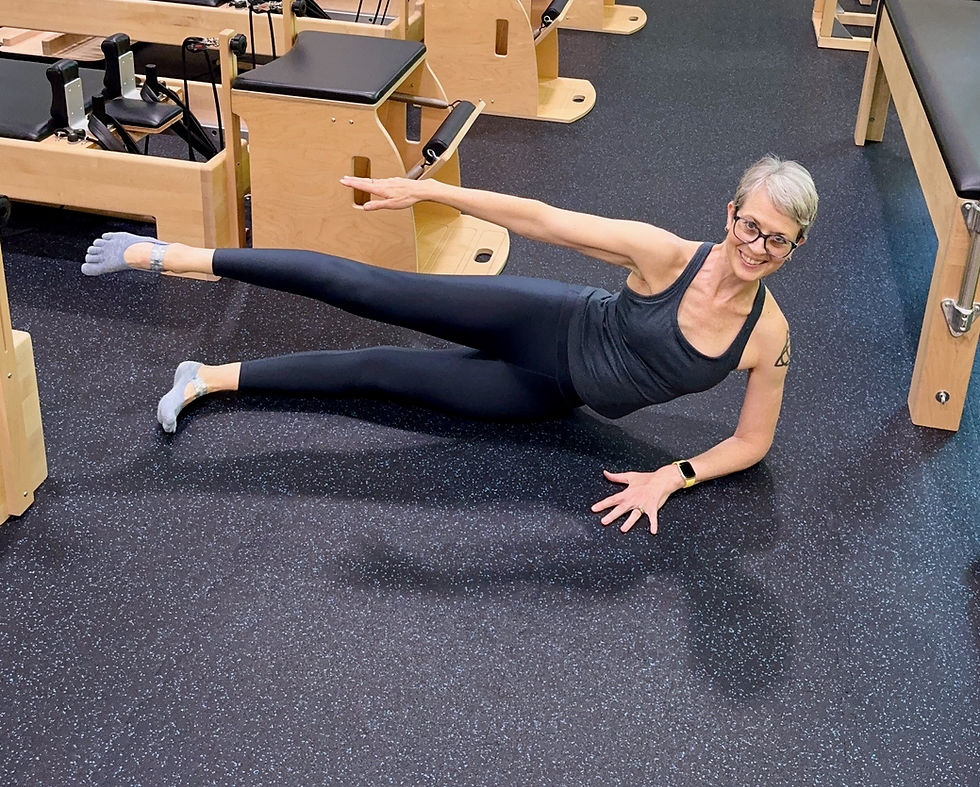
In Pilates, we encounter these challenges in many forms. Kneeling Side Kicks on the Mat, Front and Back Splits on the Reformer, and lunges on the Wunda Chair all require us to organize our bodies as the relationship between our support surface and moving limbs changes.
Rather than simply trying to hold a position, we can pay attention to how weight shifts through our feet, how the pelvis and trunk respond, and how we distribute effort throughout the body.
2. Moving the Limbs While Maintaining Trunk Control
Many Pilates exercises ask us to move one or more limbs while maintaining control of the trunk and pelvis. This requires coordination between the muscles that produce movement and those that contribute to postural stability.
Consider the Leg Pull Up on the Mat. As the legs and pelvis lift away from the supporting surface, the shoulders, trunk, and hips must coordinate to maintain the body's organization.
Similarly, exercises such as Kneeling Cat on the Trapeze challenge us to coordinate movement with the demands of the apparatus and gravity.
These exercises offer opportunities to explore how different parts of the body work together. Can the limbs move without unnecessary tension elsewhere? Can the trunk remain organized as the limbs move? Can we adjust our effort as the exercise becomes more demanding?
The goal is not rigidity. It is to develop the ability to maintain appropriate control while allowing movement to occur.
3. Working Against Resistance
Springs, straps, bars, and other Pilates apparatus provide resistance that changes throughout an exercise. This resistance creates additional demands for coordination and control.
On the Reformer, for example, the moving carriage responds to the force we apply through our feet or hands. We must organize our movements in relation to that changing resistance. In Front and Back Splits, controlling the carriage while moving through a lunge-like position requires coordination, strength, and awareness of weight distribution.
The apparatus also provides sensory feedback. We can feel how much force we apply, notice when the carriage moves unevenly, and adjust our movement accordingly.
Resistance alone does not guarantee improved proprioception. The value lies in how we respond to the resistance: sensing, adjusting, and coordinating movement with intention.
4. Changing Our Relationship to Gravity
Pilates takes us through a variety of positions, from standing and kneeling to supine, prone, inverted, and side-lying. Each position changes our relationship to gravity and the demands placed on our bodies.
Exercises on the Ladder Barrel, Spine Corrector, and Trapeze can challenge our awareness of where our bodies are positioned in space, particularly when the trunk extends, rotates, or moves beyond our usual orientation.
As we become more familiar with these positions, we have opportunities to refine our spatial awareness and coordinate movement with greater precision.
Importantly, proprioceptive training does not require extreme or inverted positions. Even a small change in orientation, limb position, or range of motion can provide a meaningful opportunity to explore body awareness.
5. Introducing Props and Unstable Surfaces
Props can change the sensory information available to us and introduce new movement challenges.
A small ball, for instance, can provide tactile feedback or change the demands of a familiar exercise. A larger physio ball can introduce instability, requiring continuous adjustments to maintain a position.
Consider a supine bridge performed with the feet supported on a physio ball. Compared with a bridge on the floor, the moving, less stable support surface creates additional demands for coordination and postural control. Progressing toward alternating heel lifts or single-leg variations increases the challenge further.
However, instability is not automatically better. The appropriate challenge depends on the individual's abilities, goals, and movement experience. A stable surface may be the better choice when learning a movement or developing strength and control.
The intention is not to make an exercise difficult simply for the sake of difficulty. It is to choose a challenge that encourages an appropriate and effective response.
What Is the Relationship Between Proprioception and Balance?
Proprioception contributes to balance, but balance relies on more than proprioceptive information alone.
To maintain balance, the nervous system integrates information from several sources:
Somatosensory information: Input from the feet, skin, muscles, and joints helps us sense contact with a surface and changes in body position.
Vision: Our eyes provide information about our surroundings and our movement in relation to them.
Vestibular information: The inner ear helps us detect head movement and orientation relative to gravity.
The nervous system combines this information with muscular strength, coordination, and postural strategies to maintain stability or recover when we lose it.
Injury, neurological conditions, reduced activity, and aging can affect aspects of balance. Yet balance is also trainable, and appropriately designed exercise can help people practice the physical and sensory demands involved.
Pilates provides many opportunities to do this, from maintaining alignment during a standing exercise to coordinating movement on a moving carriage or controlling the trunk while the limbs change position.
The key is to select exercises that challenge the individual appropriately and progress them as strength, coordination, confidence, and control develop.
Bringing Greater Awareness to Your Pilates Practice
One of the most useful ways to explore proprioception is to become curious about what you feel during an exercise.
Rather than focusing exclusively on completing a movement, pause to consider a few questions:
Where is my weight distributed through my supporting surface?
What happens to my balance when I move one limb?
Can I sense the relationship between my pelvis, trunk, and limbs?
Am I using more effort than the movement requires?
How does the movement change when the apparatus, resistance, or base of support changes?
These questions shift our attention from simply performing an exercise to investigating how we move.
This approach is central to my teaching philosophy. I think of the Pilates practitioner as a body investigator: someone who develops movement awareness through observation, thoughtful experimentation, and practice.
We are not just learning a sequence of exercises. We are developing our ability to recognize movement patterns, make adjustments, and coordinate our bodies in response to changing demands.
A Practice to Explore
If you would like to explore these concepts in your own practice, try this brief Mat-based Pilates session using a ball.
As you move, notice how the ball changes your relationship to the supporting surface, how your weight shifts, and how your body responds to each transition. You don't need to make the movements bigger or more complicated. Instead, pay attention to the information your body receives and how you respond to it.
You can also follow along on Instagram, where I share Pilates exercises and sequences that explore balance, proprioception, and the ways we organize movement across the Mat and apparatus.
The Takeaway
Balance and proprioception are interconnected components of movement that rely on sensory information, nervous system processing, muscular strength, and coordination.
Pilates gives us a versatile environment in which to explore these relationships. By changing our base of support, moving the limbs while controlling the trunk, working against resistance, altering our orientation to gravity, and incorporating props, we can challenge our ability to sense and respond to movement.
Ultimately, the goal is not simply to perform a more difficult exercise. It is to develop greater awareness, appropriate control, and the ability to adapt as movement demands change.
The more we understand how we move, the more opportunities we have to make our practice purposeful.
Align. Strengthen. Thrive.


Comments