Why Rotation Matters: How Pilates Helps You Move Better for Life

The Body Was Designed to Spiral
Nature favors spirals. The human body does too.
Whether we're reaching into the back seat of the car, carrying groceries, serving a tennis ball, swinging a golf club, or simply walking, we rarely move in perfectly straight lines. Healthy movement depends on the body's ability to rotate with both mobility and control.
Yet rotation is often one of the first movement qualities we begin to lose. Hours spent sitting, repetitive movement patterns, injury, and even the natural aging process can reduce mobility through the thoracic spine and hips. When that happens, the body often compensates by asking the lumbar spine or shoulders to move beyond what they're designed to do.
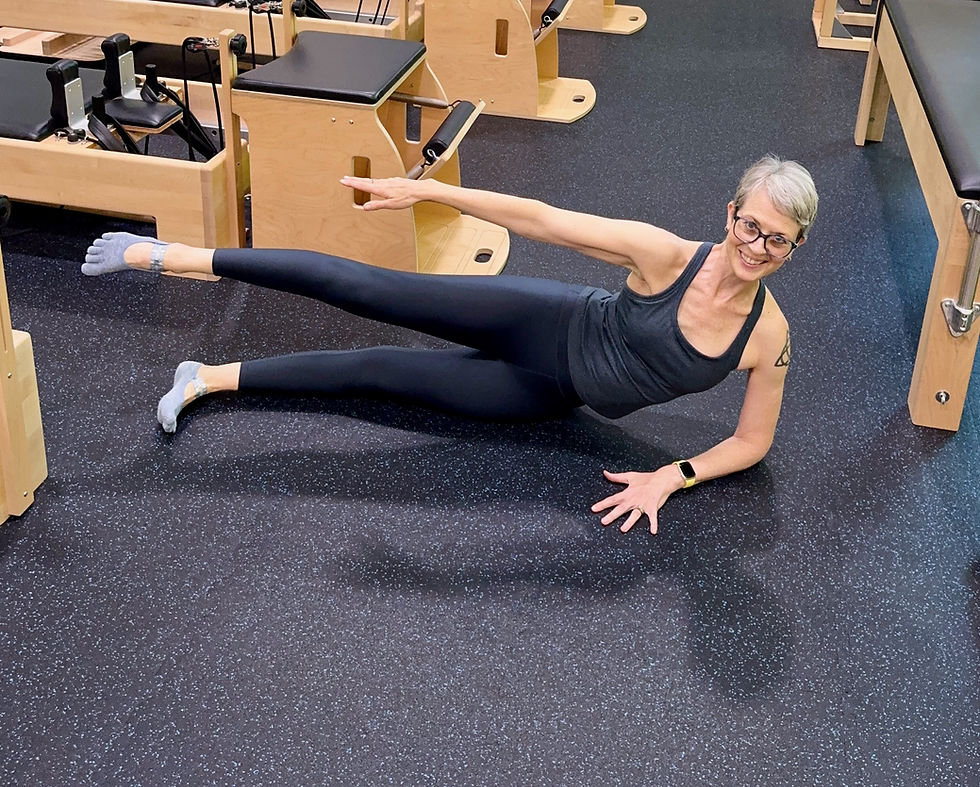
Pilates gives us the opportunity to practice rotational movement intentionally. Through mindful movement, we learn to coordinate the spine, pelvis, and hips so that rotation becomes efficient, balanced, and integrated throughout the entire body.
Why Rotation Matters
Rotation is fundamental to the way we move.
Every step we take, every swing of a racket or golf club, every dance phrase, and every reach across the body depends on rotational force transfer. Efficient movement isn't created by the arms or legs working independently—it begins with an organized center that can generate, transfer, and control force throughout the body.
In Pilates, we don't simply practice twisting. We develop awareness of how rotation originates, how it is supported by the center, and how it travels through the entire kinetic chain. This coordinated approach helps create movement that feels both powerful and effortless.
The Thoracic Spine and Hips Work Together
One of the most common movement patterns I observe is a lack of mobility through the thoracic spine.
When the upper back becomes stiff, the body often compensates by rotating through the lumbar spine, an area designed primarily for stability rather than large amounts of rotation. Over time, these compensations can contribute to inefficient movement and unnecessary strain.
Pilates encourages healthy movement by restoring:
Thoracic rotation
Hip dissociation
Pelvic organization
Whole-body coordination
When these regions work together, movement becomes smoother, more efficient, and less reliant on compensation. Instead of forcing motion from one area, the body begins to share the work across the entire system.
Rotation Supports Healthy Aging
Rotation isn't just important for athletes. It's essential for living well.
The ability to rotate comfortably contributes to efficient walking, better balance, smoother gait mechanics, healthy breathing, and maintaining spinal mobility throughout life. It also supports the body's fascial system, allowing tissues to glide and adapt as we move through different environments and daily activities.
Developing rotational capacity isn't about becoming more flexible. It's about maintaining the ability to move with confidence, efficiency, and resilience as we age.
For me, that's one of the greatest gifts of a consistent Pilates practice.
Bringing Rotation Into Your Practice
One of the beautiful aspects of the Pilates method is that rotational movement appears throughout the entire system. Whether you're practicing on the Mat, Reformer, Chair, Tower, or Barrel, each apparatus offers unique opportunities to explore how the spine and hips work together.
Throughout August, I'll be highlighting rotational exercises across the Pilates system on Instagram, demonstrating how different pieces of equipment challenge and support this important movement principle.
If you're new to Pilates, begin by paying attention to quality rather than quantity. Focus on moving with control, maintaining length through the spine, and allowing your breath to support the movement. Often, small, well-organized rotations provide greater benefit than simply trying to twist farther.
Practice With Me
Throughout August, I'm releasing a series of new Pilates videos on my YouTube Channel, each designed to help you move with greater strength, mobility, and confidence.
The first video—a 9-Minute Mat Practice with a Ball—is available now, with additional videos released each week throughout the month. Together, they explore a variety of movement concepts while providing practical ways to incorporate Pilates into your daily routine.
Whether you have nine minutes or twenty, I hope you'll join me in moving with intention.
Final Thoughts
Rotation reminds us that movement isn't rigid—it's responsive.
Whether you're walking the dog, gardening, practicing Pilates, playing tennis, or simply reaching for something on a high shelf, the ability to rotate with control allows movement to feel effortless rather than forced.
Pilates teaches us that efficient movement is not about doing more. It's about moving with greater awareness, organization, and purpose.
As you move through this month, I invite you to notice the spirals already present in your everyday life—and to appreciate the remarkable design of the body that allows them to happen with grace.
Thank you for reading, and as always…
Align. Strengthen. Thrive.


Comments